

How to Set Up a Plastic-Free Kitchen: A Practical Australian Guide
Most of us never sit down and decide to fill the kitchen with plastic. It just creeps in, one cheap container and one roll of cling film at a time, until the drawer won't shut and half the lids have gone missing. So the idea of a plastic-free kitchen can feel like a big weekend project you keep putting off.
It doesn't have to be. The version that actually works is slow. You replace things as they wear out, and you choose the swap that lasts longer and looks better on the bench. Do it that way and within a year most of the plastic is gone without you ever noticing the cost in one hit.
Here is the order we'd tackle an Australian kitchen, starting with the things you touch every single day.
1. Sort out the wraps and the foil drawer first
Cling film, foil and baking paper are the quiet plastic problem. The film itself is single-use, the boxes fall apart, and the cardboard cutter never works after the first month, so you end up tearing sheets with your teeth. This is usually the messiest drawer in the house.
The fix is twofold. Reach for reusable options where you can: beeswax wraps for covering a bowl, a plate on top of leftovers, or a proper container for anything going in the fridge. For the rolls you do keep, store them in one tidy holder with a built-in cutter so they stop unravelling and you stop buying replacements. We go deep on this in how to store cling wrap, foil and baking paper in one tidy spot.

2. Rethink how you store leftovers and bags
The container cupboard is where plastic multiplies. Stained takeaway tubs, warped lids, mystery containers from three flatmates ago. Swapping to glass or stainless for leftovers is an easy win, and it makes the fridge look a hundred times calmer.
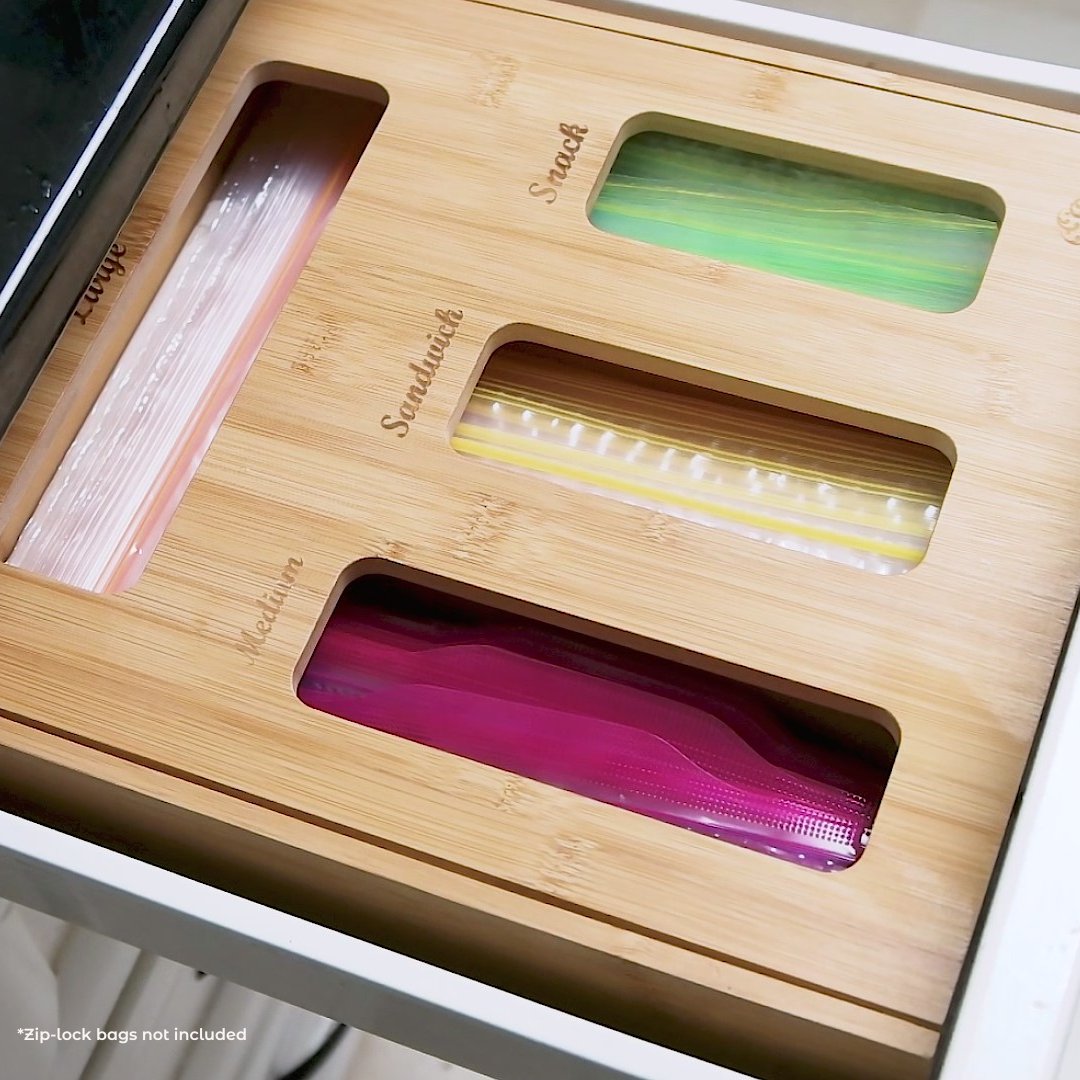
Then there is the zip-lock and snap-lock bag drawer, which somehow ends up worse than the wraps. Boxes split, bags tangle, and you can never find the size you want. If you are keeping bags for school lunches and freezing portions, the trick is to corral them by size so the drawer stops fighting back. Our full method is in how to organise zip-lock and sandwich bags, and a bamboo bag organiser does the heavy lifting.
3. Free up the bench with better knife storage
Plastic knife blocks are bulky, they trap moisture and crumbs in slots you can never clean, and the plastic yellows over time. A magnetic holder skips all of that. The knives sit out in the open, they dry properly, and you wipe the whole thing down in seconds.

A bamboo magnetic knife holder also takes up a fraction of the bench space a block does, which matters in a smaller Aussie kitchen. There is more on doing this safely in how to store kitchen knives safely without a bulky block.
4. Upgrade your boards and prep surfaces
Plastic chopping boards scar with every cut, and those grooves hold onto bacteria and odours no matter how hard you scrub. They also shed tiny plastic flecks into your food, which is exactly what you are trying to avoid.
Bamboo boards are harder than most timber, gentle on your knife edges, and they wash up clean. A chopping board set with a stand keeps boards upright and drying instead of stacked in a damp pile, which is half the battle with any timber board.

Why bamboo does the heavy lifting here
You will notice bamboo keeps coming up. There is a reason. It is technically a grass, not a tree, so it grows back fast without replanting, which makes it one of the more renewable materials you can put in a kitchen. It is naturally hard-wearing, it resists moisture better than soft timbers, and it simply looks warmer on the bench than plastic ever will.
It is not indestructible, though. Bamboo lasts for years if you treat it right and warps in a week if you leave it soaking. We cover the simple care routine in how to care for bamboo kitchenware so it lasts for years.
Where to start if you only do one thing this week
Pick the drawer or bench spot that annoys you most and fix just that. For a lot of people that is the wrap drawer or the bag chaos. Sort one zone, feel how much calmer it is, and the rest tends to follow on its own.
If you would rather do it in a single tidy go, the kitchen organising bundle brings the bag organisers and storage together so you can reset a whole zone at once.
A plastic-free kitchen isn't about being perfect. It is about choosing things that last the next time you need to replace something, so the plastic slowly leaves and never really comes back.