

What to Look for When Buying Bamboo Kitchenware: A Buyer's Guide
Bamboo has become the default material for "eco" kitchen gear, and that is mostly a good thing. It grows fast, it is hard-wearing, and it looks warm on a benchtop. But not all bamboo kitchenware is made the same way, and the gap between a piece that lasts ten years and one that splits within a season comes down to a handful of things you can check before you buy. This guide walks through what to look for, what the labels actually mean, and which questions are worth asking a seller.
Why bamboo, and why it is not automatically "sustainable"
Bamboo is technically a grass. It reaches harvest size in three to five years, regrows from the same root system without replanting, and needs very little water or fertiliser compared with hardwood timber. That is the honest case for it.
The catch is what happens after harvest. Bamboo stems are hollow, so nearly every bamboo product you buy is made from strips that have been cut, dried, pressed and glued together. The quality of that processing (and the adhesive used) decides whether the finished piece is a good buy. A cheap bamboo board with weak glue and poor drying is not sustainable in any meaningful sense, because it ends up in landfill after a year.
So the question is not "bamboo or not bamboo". It is "which bamboo".

1. Check the construction: how the strips are laid
Turn the piece over and look at the edges. You will usually see one of three patterns.
Flat grain (horizontal)
Wide strips laid flat, so you see the bamboo nodes across the surface. This is the most common style for boards and organisers. It is stable and affordable, and fine for general use.
Vertical grain
Narrower strips stood on edge. Denser and more resistant to knife marks, which makes it a better choice for a daily chopping board.
End grain
Small blocks arranged so the fibres point up at you, like a butcher's block. Kindest to knife edges and self-healing to a degree, but heavier and pricier. Worth it if you cook seriously; overkill for a serving board.
Whatever the pattern, look for tight, even joins with no visible gaps or glue lines. Uneven strips are a sign of rushed pressing and a piece that is more likely to warp.
2. Ask about the adhesive
This is the one most people skip, and it matters. Because bamboo products are laminated, they contain glue, and the two things to check are formaldehyde content and food safety.
Look for products described as using food-safe or formaldehyde-free adhesive, or that meet a recognised low-emission standard (E0 and E1 are the common labels; E0 is the lower emission level). Reputable sellers will state this plainly. If a listing says nothing about the glue at all, that is worth a question before you buy, particularly for anything that touches food directly like a chopping board.
3. Look at the finish
Bamboo needs a finish to resist moisture. The good options are food-grade mineral oil, a mineral oil and beeswax blend, or a plant-based hardwax oil. These soak into the fibres and can be reapplied at home.
Be wary of pieces with a thick, glossy varnish or lacquer. It looks smart in the box, but varnish sits on top of the surface, chips under knives, and cannot be renewed. Once it cracks, water gets underneath and the board starts to swell. For serving trays and organisers that never see a knife, a light lacquer is acceptable. For anything you cut on, oil is the right answer.
We covered the maintenance side in detail in our guide to caring for bamboo kitchenware, but the short version is: an oiled finish is one you can look after for years.

4. Weight and thickness tell you a lot
Pick it up. Well-pressed bamboo is dense and feels heavier than you expect for its size. A board that feels light for its footprint has probably been made from thinner or less compressed strips, and thin bamboo is the kind that cups and cracks.
For chopping boards, a thickness of around 15 to 20 mm is a sensible minimum for daily use. Serving boards can be thinner. For drawer organisers and dispensers, thickness matters less than rigidity, so check that the walls do not flex when you press them.
5. Check the details that make it usable
Good bamboo kitchenware is designed as much as it is manufactured. A few things worth checking:
Juice grooves. A groove around the edge of a chopping board stops meat juice and tomato pulp running onto the bench. Our three-board set has them on every board, along with a stand so they dry upright instead of sitting in a puddle.
Anti-slip feet or bases. A board that slides is unsafe, and a knife holder that slides is worse. Look for rubber or silicone pads underneath.
Magnet strength on knife holders. A magnetic block should hold a heavy chef's knife firmly without you needing to press it on. The hexagonal magnetic knife holder is double-sided for that reason: twelve knives, no slots to trap moisture, and the bamboo protects the blade edge on contact.
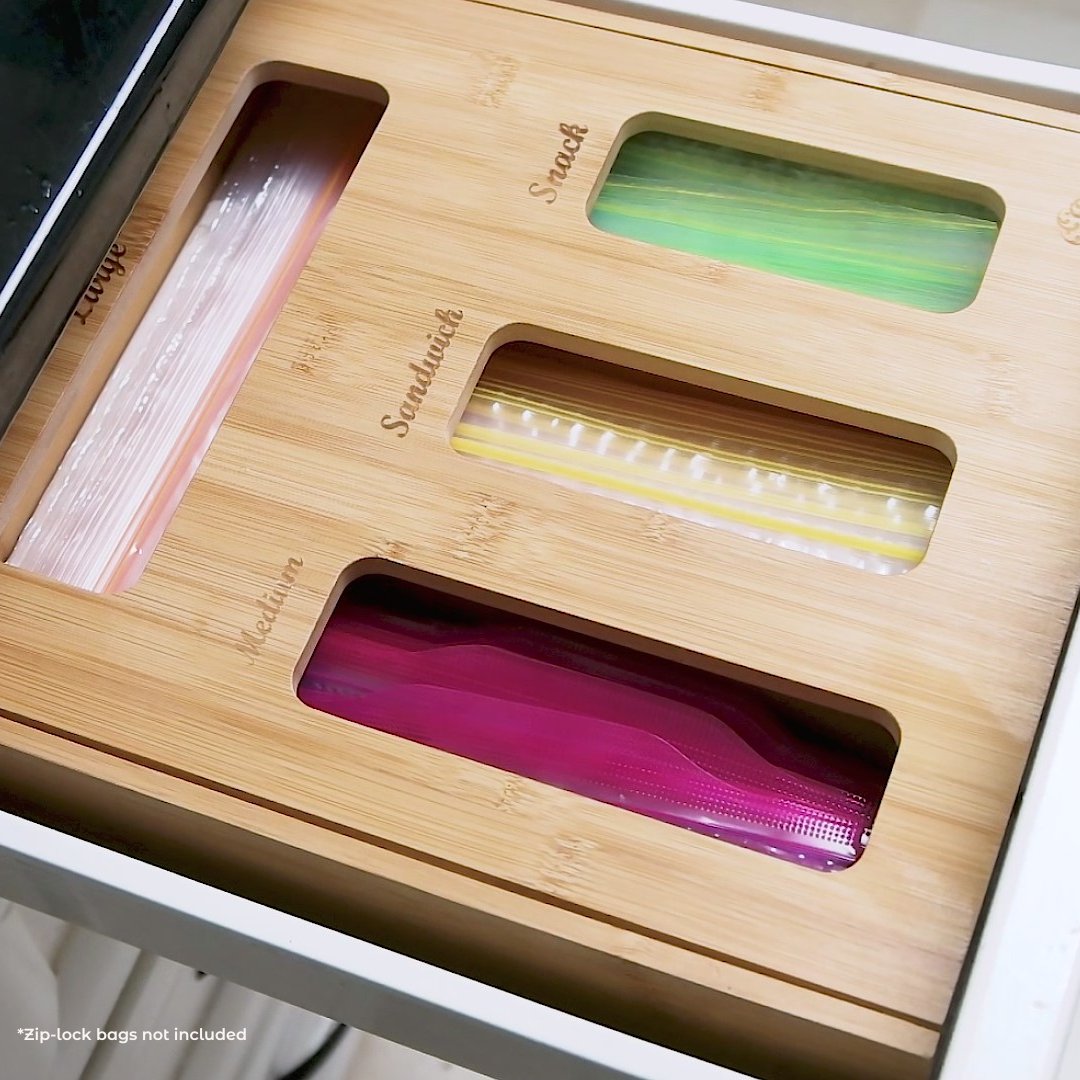
Working parts. On a wrap dispenser, test the cutter. On a bag organiser, check that lids slide without catching. Cheap hardware on a good bamboo body is a common shortcut.

6. Read the sizing, twice
Bamboo organisers are often photographed on generous benchtops that make them look smaller than they are. Before buying a drawer organiser or dispenser, measure your drawer's internal depth and height, not just the width. Sliding lids need a few centimetres of clearance to open fully. Our product pages include dimension diagrams for exactly this reason, and it is the single most common thing customers wish they had checked.
For chopping boards, think about your sink. A large board is lovely to work on and awful to wash if it does not fit flat under the tap.
7. Look past the buzzwords
"Organic", "natural" and "eco-friendly" are not regulated terms on kitchenware, so they tell you very little on their own. More useful signals are:
A seller who states the adhesive type, the finish, and the thickness. Clear photos of the edges and underside, not just styled shots. Care instructions included, which suggests the maker expects the product to last. And an Australian-based business you can actually contact if something goes wrong.
If you are still weighing bamboo against the alternatives, our comparison of bamboo, plastic and timber chopping boards goes through the trade-offs honestly, including where bamboo is not the best pick.
A quick checklist to take shopping
Tight, even joins with no gaps. Food-safe or low-emission adhesive stated. Oil finish rather than thick varnish for anything you cut on. Feels dense and heavy for its size. Anti-slip base. Working parts that operate smoothly. Dimensions that suit your drawer, bench and sink. Care instructions supplied.
If a product ticks those, it is the kind of bamboo that earns its "sustainable" label by still being in your kitchen a decade from now. That is the whole point. Swapping a plastic organiser for a bamboo one only helps if the bamboo one lasts.
For more on building a kitchen that avoids single-use plastic altogether, start with our plastic-free kitchen guide, or browse the Essentials Bundle if you want the chopping board set and wrap dispenser together.