

Kitchen Spring Clean: A Weekend Reset Checklist
Spring lands on 1 September, and it tends to arrive in the kitchen before it arrives anywhere else in the house. Winter cooking leaves a trail. Half-used jars at the back of the pantry, a freezer full of unlabelled containers, a drawer that has stopped closing properly. A spring clean is your chance to reset all of it before the weather turns and dinner starts moving outside again.
This does not need to be a two week project. Everything below fits into a weekend, and most of it costs nothing at all. Work through it in order, because each step makes the next one quicker.
First, set up a staging area
Clear the dining table or a stretch of bench and give yourself four spots: keep, relocate, donate, bin. Run the dishwasher and empty the sink before you start, because you will need somewhere to wash things as you go. Put a bin bag and a recycling box within arm's reach so you are not walking back and forth all morning.
Set a timer for each zone. Forty-five minutes is usually plenty, and the deadline stops you disappearing down a nostalgia hole over a bread maker you have used twice.
Step 1: The fridge and freezer
Pull everything out onto the bench. Check dates, smell anything you are unsure about, and be honest about the condiments. Most fridges are carrying at least three sauces nobody has touched since last summer.
Wipe the shelves with warm water and a splash of white vinegar, then dry them properly before anything goes back. As you restock, group like with like: dairy on one shelf, leftovers at eye level where you will actually see them, raw meat on the bottom so nothing drips onto anything else. If leftovers are your weak point, our guide on storing leftovers without plastic covers what genuinely works and what just creates more washing up.
In the freezer, label anything unlabelled with a marker and masking tape. Anything you cannot identify goes. Anything older than three months moves to the front to be eaten first.
Step 2: The pantry
Same approach, one shelf at a time so you are never staring at an empty cupboard and an overflowing bench. Check dates on flours, nuts and spices in particular, because these go stale faster than people expect, especially through a humid Australian summer.
Decant what makes sense and leave the rest alone. You do not need matching jars for everything. Group by how you cook rather than by category: baking together, weeknight staples together, snacks somewhere the kids can reach without climbing. Our budget pantry organisation guide goes deeper if this is the zone that always gets away from you.
Step 3: Drawers and the cupboard under the sink
This is where a spring clean pays off most, because drawers absorb clutter quietly. Tip each one out, vacuum the crumbs, wipe the base, then only put back what earns its place.

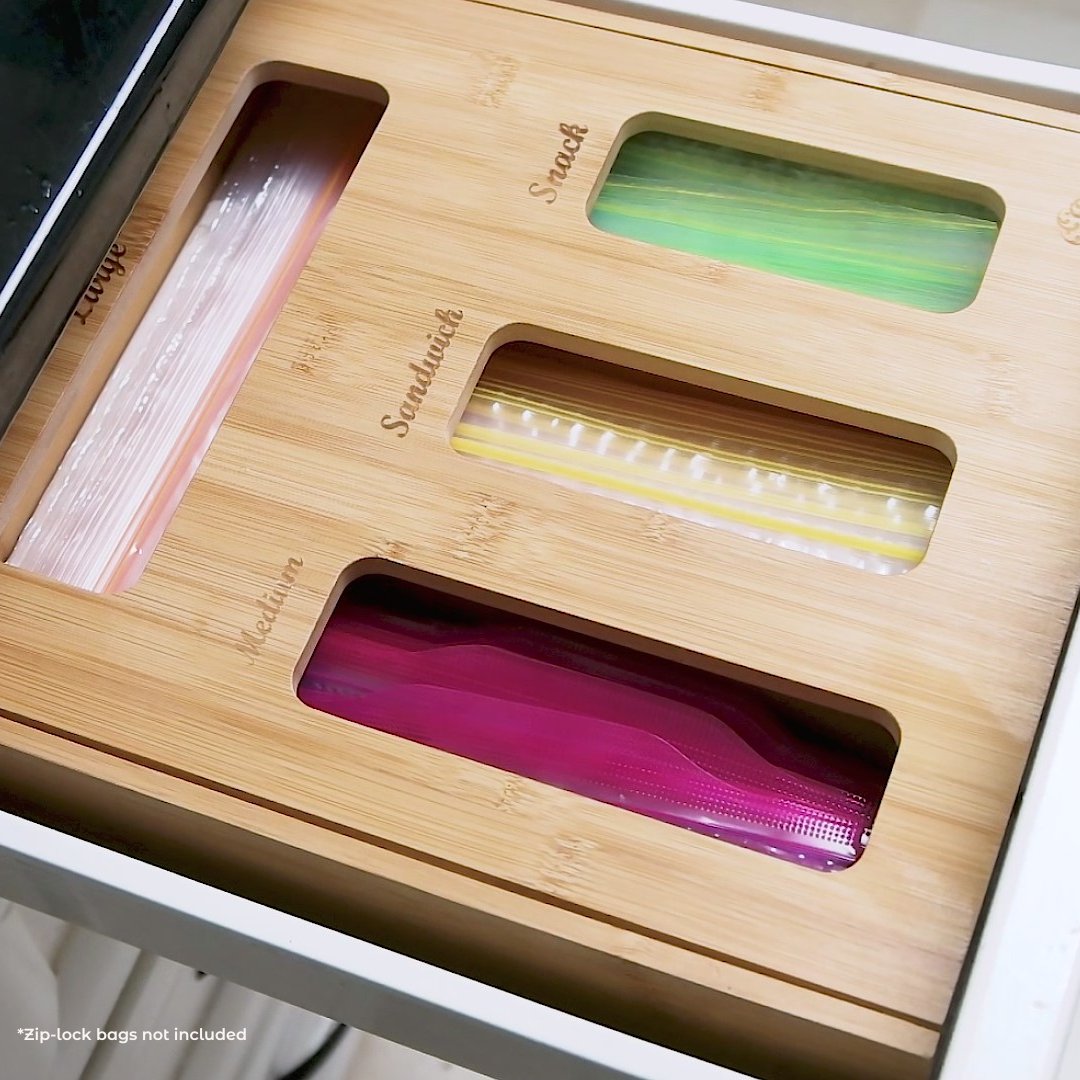
The usual offenders are plastic bags, wraps and duplicate utensils. Bags in particular tend to live loose in a drawer and multiply. A 4-in-1 bamboo bag organiser keeps snack, sandwich, medium and large sizes separated in one container, so you can pull one out with one hand while the other is holding a lunchbox. If the whole drawer is the problem rather than one corner of it, we have a full walkthrough on decluttering and organising kitchen drawers.
Under the sink, check for leaks while everything is out of the way. Move cleaning products out of reach of small hands, and consolidate while you are at it. There is rarely a good reason to own four different sprays.
Step 4: Benchtops and the daily drivers

Benchtops set the tone for the whole room. The rule that works: if you do not use it most days, it lives in a cupboard. Everything that stays out should have a home you can reach without moving something else first.
Rolls of cling wrap, foil and baking paper are the classic bench clutter, sliding around a cupboard in torn boxes with the cutters long gone. A 3-in-1 bamboo wrap dispenser holds all three in one unit with a built-in slide cutter, and it sits flat in a drawer or upright in a cupboard depending on the space you have.
Step 5: Give the bamboo and timber a proper once over

Boards, holders and utensils in bamboo or timber benefit from an annual reset. Wash them in warm soapy water, never in the dishwasher, and dry them standing up so air reaches both sides. If a board looks dry or pale, or feels rough under your hand, it is asking to be oiled. Food-grade mineral oil, rubbed in with a cloth and left overnight, brings the surface back and helps it shed moisture for months.
While you are there, check your boards for deep knife scoring. Grooves hold moisture and bacteria, so a heavily scarred board is worth retiring. A bamboo chopping board set with separate boards for raw meat, produce and bread also solves the cross-contamination problem in one go. Full care instructions are in our guide on caring for bamboo kitchenware.
What to do with everything you pulled out
The pile on the table is the part most spring cleans get wrong, because it sits there for a fortnight and then quietly goes back in the cupboard. Deal with it the same day.
- Unopened, in-date food goes to a food bank or a neighbour. Most Australian councils list local drop-off points on their website.
- Working appliances and duplicate utensils go to an op shop, in the boot of the car tonight so they actually leave the house.
- Soft plastics, batteries and small electricals usually need a specific drop-off rather than the kerbside bin. Check your council before you assume.
- Chipped or cracked ceramics go in general waste. They are not recyclable with glass.
The short version
If you only have a couple of hours this weekend, do these five things:
- Empty and wipe the fridge, then restock it by zone.
- Bin anything out of date in the pantry and pull the rest forward.
- Tip out your worst drawer and only put back what you use.
- Clear the benchtop down to daily items.
- Wash and oil your boards.
Making it stick until next spring
The kitchens that stay tidy are not the ones with the most storage. They are the ones where everything has an obvious home and putting things away takes less effort than leaving them out. That is the whole trick, and it is why a spring clean that ends in better systems lasts, while one that ends in a tidier mess does not.
If a couple of zones need a container rather than a rethink, our Kitchen Organising Bundle pairs the bag organiser with the wrap dispenser, which between them handle the two messiest drawers in most Australian homes. And if the clean-out has you thinking bigger, our plastic-free kitchen guide is the place to start on what to replace as things wear out.