

A Beginner's Guide to a Low-Waste Kitchen
Low-waste kitchens have an image problem. Search the phrase and you get spotless pantries full of matching glass jars, a compost setup that looks like it needs council approval, and someone cheerfully suggesting you make your own oat milk. It looks great. It also has very little to do with a Tuesday night, half a bag of spinach going slimy in the crisper, and nobody having the energy to cook the thing you bought it for.
The useful version is much smaller. A low-waste kitchen is simply one where less food gets binned, fewer single-use things get bought, and the gear you own lasts long enough that you stop replacing it. That is the whole idea. You can get most of the way there in about a month, without buying a single matching jar.
Start by working out what you are actually wasting
Most people guess wrong about this. They assume the problem is packaging, so they buy tote bags and beeswax wraps, and then keep throwing out the same three cucumbers every fortnight.
For one week, keep a scrap of paper on the fridge and write down anything you bin or tip out. No judgement, no tallying grams, just a list. At the end of the week you will almost certainly see a pattern, and it usually falls into one of three buckets:
- Fresh food that went off before you got to it. This is the big one for most Australian households, and it is a storage and planning problem more than a shopping problem.
- Single-use wrap, bags and paper. Cling film, foil, baking paper, zip-lock bags, paper towel.
- Things that broke. Plastic containers with warped lids, a peeling chopping board, a cheap knife block that never quite fit.
You will get far more out of fixing whichever bucket is biggest than out of following a generic list of swaps. If your bin is mostly limp vegetables, a set of reusable produce bags will not help you.

Fix the food waste first
Roughly speaking, the food you throw out cost more (in money and in emissions) than the packaging it came in. It is also the easiest thing to change, because it does not require buying anything.
Shop for the week you will actually have
Not the week you are hoping for. If you know Thursday is a late one, do not buy Thursday's ingredients. Two solid plans and a fallback beat five ambitious ones.
Give leftovers a visible home
Leftovers die in the back of the fridge. Clear one shelf at eye level and make it the leftovers shelf, so what needs eating is the first thing you see when you open the door. We have a longer piece on how to store leftovers without plastic if you want the detail on containers and timing.
Learn the three storage rules that matter
Herbs last twice as long standing in a jar of water. Bananas ripen everything around them, so keep them apart. Most leafy greens want a dry cloth or paper in with them to soak up condensation. That is genuinely most of it.
Then cut the single-use habits, one at a time
Here is the part people get wrong. They throw out every plastic thing they own in a burst of enthusiasm, replace it all in one weekend, and create a pile of waste in the process. Use what you have until it dies, then replace it with something better.
When something does need replacing, the swaps worth making are the ones that make the low-waste option the easy option:
- Containers over cling film. If a container with a working lid is within arm's reach, you will use it. If it is under a landslide of mismatched lids, you will reach for the cling wrap.
- Beeswax or silicone for covering bowls. Good for a bowl of dough or half a watermelon, less good for anything you want properly airtight.
- Washable cloths for paper towel. Keep a stack of cheap cotton cloths somewhere obvious and the roll somewhere annoying. Placement does the work.
- Reuse the zip-lock bags you already own. Rinse, dry and reuse anything that has not held raw meat. A bag used ten times is worth more than a bag you feel guilty about.
Storage is what makes it stick
This is the unglamorous truth behind every low-waste kitchen that lasts more than a fortnight. The habit does not fail because people stop caring. It fails because the sustainable option takes eleven seconds longer than the throwaway one, and eleven seconds is enough.
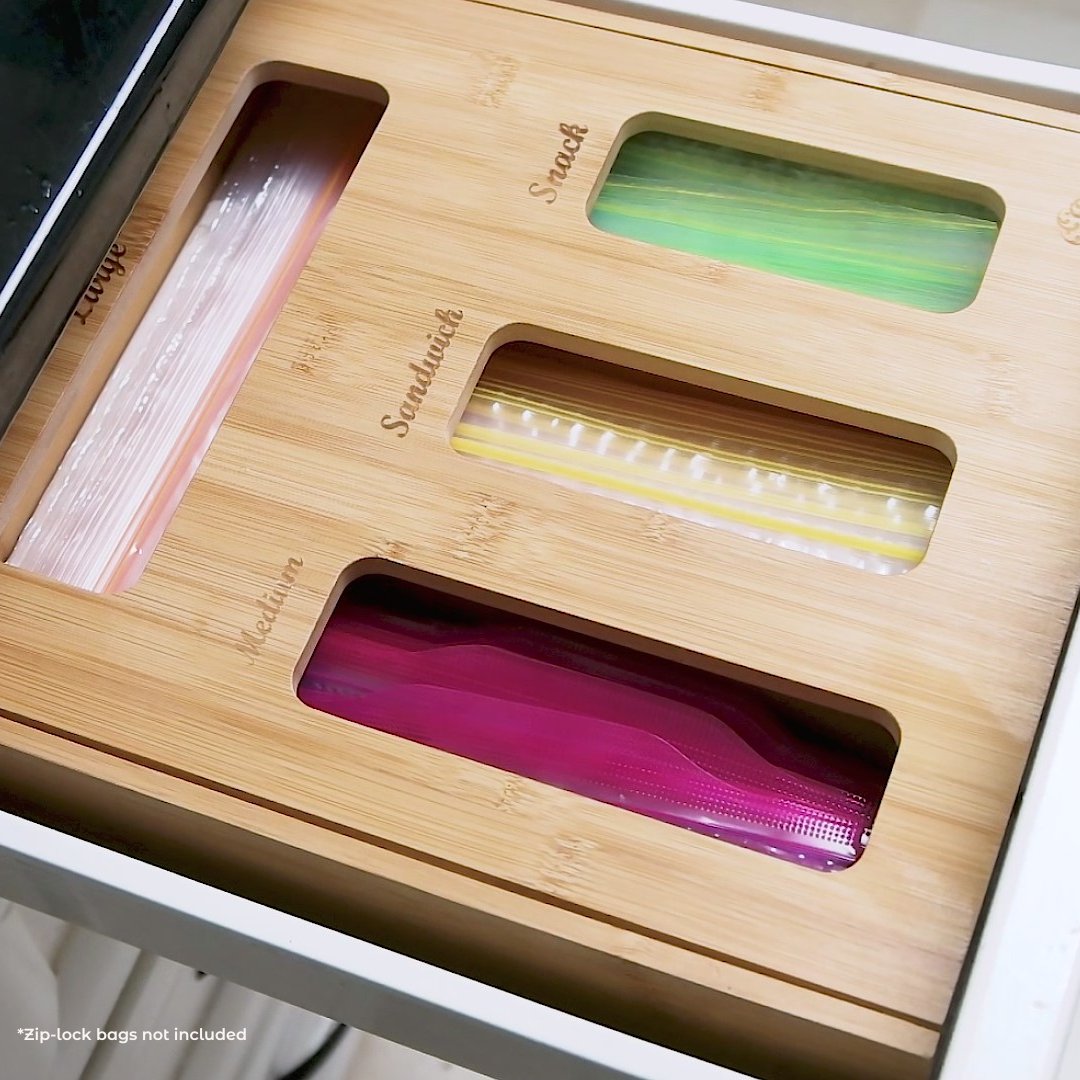
So the goal is not more storage, it is storage that removes friction. A drawer where the wrap rolls unravel and the bags migrate into three separate corners will quietly push you back towards buying more of everything, because you cannot see what you already have.

Two things helped most in our own kitchens. The first is keeping cling wrap, foil and baking paper together in one 3-in-1 bamboo dispenser with a built-in cutter, so the rolls stop shredding themselves and you can see exactly how much is left before you buy more. The second is sorting bags by size in a 4-in-1 bamboo bag organiser instead of letting four half-empty boxes fight it out in a drawer.
Neither is essential to a low-waste kitchen. Both remove the friction that makes people give up on one.
Buy fewer things, and buy them once
The most sustainable item is the one you do not replace in two years. When you are choosing something new, three questions cover it:
- Is it repairable or refinishable? A timber or bamboo board can be sanded and re-oiled for years. A scratched plastic one is done.
- Does it do more than one job? Fewer, better tools beat a drawer of single-purpose gadgets.
- Will you still like it in three years? Sounds shallow. It is not. Things you like get looked after.

Bamboo does well on all three, which is why our bamboo chopping board set is built to be oiled rather than binned. It is a grass, not a hardwood, so it regrows in a few years rather than a few decades, and it takes an oil finish beautifully. It does need a little looking after, and our guide on caring for bamboo kitchenware covers the five minutes a month that keeps it going.
A realistic first month
Week one: track what you bin. Change nothing else.
Week two: clear the leftovers shelf and fix your fresh food storage. Expect this alone to cut your food waste noticeably.
Week three: tidy the wrap and bag situation so you can see what you own. Stop buying duplicates.
Week four: pick one single-use habit and replace it properly. Just one.
That is a month. No jars, no guilt, no oat milk.
Where to go from here
If you want the fuller version, our practical Australian guide to setting up a plastic-free kitchen goes room by room, and eco-friendly kitchen swaps under $50 covers the changes worth paying for when you are ready.
And if you would rather start with the storage and let the habits follow, the Kitchen Organising Bundle pairs the wrap dispenser with the bag organiser, which between them handle the two drawers that cause most of the trouble.
Start with the bin. It will tell you what to do next.